


When AI Guessing Becomes Dangerous
Imagine a surgeon in the middle of a critical operation asking an assistant for the dosage of a rare anesthetic. Instead of consulting the hospital’s verified protocol, the assistant closes their eyes, recalls a textbook from years ago, and confidently guesses the dosage.
That would be terrifying.
In AI systems, this behavior has a name: hallucination.
For casual applications—writing poetry or generating marketing copy—hallucinations are mostly harmless. But in mission-critical environments such as aerospace, finance, healthcare, or legal systems, an AI that “sounds confident but guesses” is unacceptable.
As organizations rapidly adopt generative AI, a critical misconception persists:
Many teams focus on prompts when they should be focusing on architecture. Reliable Enterprise AI is not built through clever prompts; it is engineered through retrieval, context design, and verification layers.
From Judges to Creators: The Shift in AI
Traditional machine learning systems were primarily discriminative. Their job was classification:
- Is this email spam?
- Is this image a cat or a dog?
- Is this transaction fraudulent?
They were excellent judges.
Modern generative models (LLMs) are fundamentally different. They learn statistical patterns and generate text based on probability distributions learned from massive datasets.
These models are powerful – but they have an important limitation: they do not have persistent memory.
An LLM does not inherently remember:
- Your internal company documents.
- Your latest product specifications.
- What happened in a meeting ten minutes ago.
It only knows what exists inside its training data and the prompt context window.
If we want AI to answer questions about proprietary or recent information, we need an external knowledge system: the foundation of a Reliable Enterprise AI.
The Real Bridge: Embeddings and Semantic Search
Before an AI system can retrieve relevant information, text must be converted into a form machines can compare mathematically.
This is done through embeddings.
An embedding model transforms text into a high-dimensional vector that captures semantic meaning. Example:
“aircraft maintenance protocol” → `[0.23, -0.88, 0.41, ...]`Documents with similar meanings produce vectors that are close in “vector space”.
This enables semantic search rather than simple keyword matching.Instead of searching for exact words, the system retrieves documents based on meaning similarity.
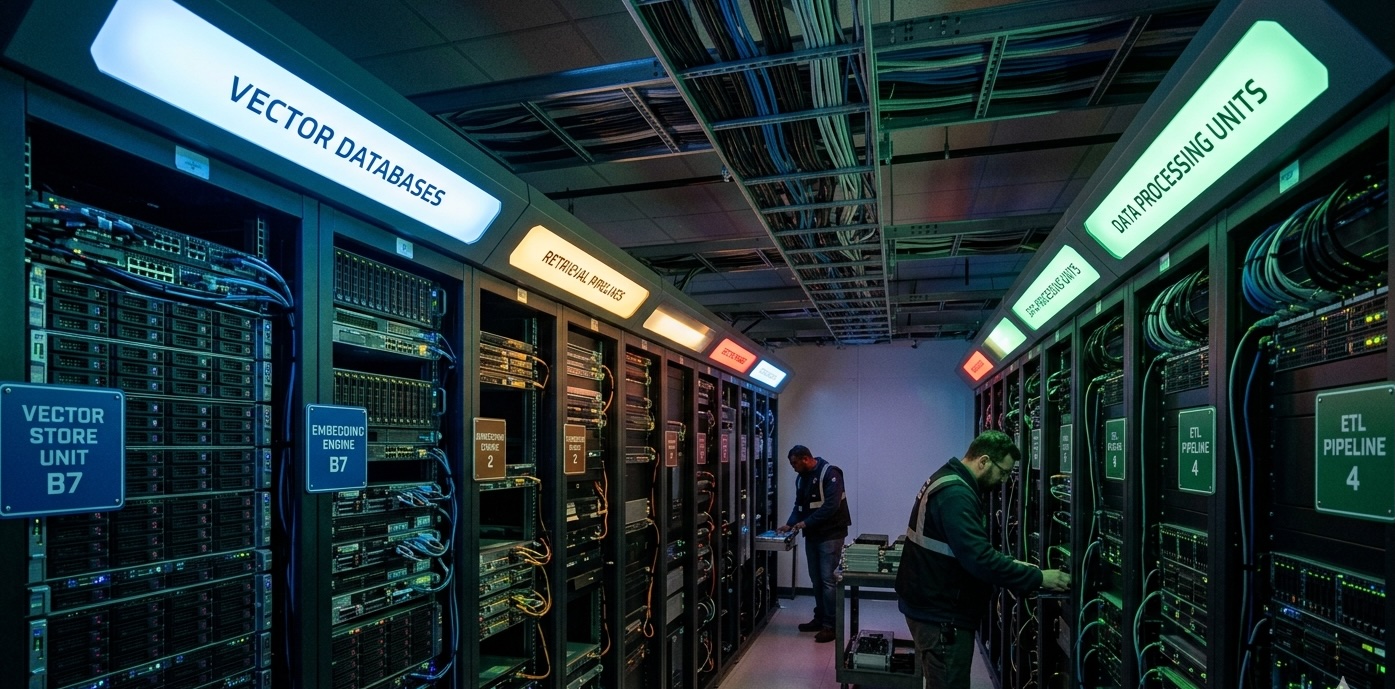
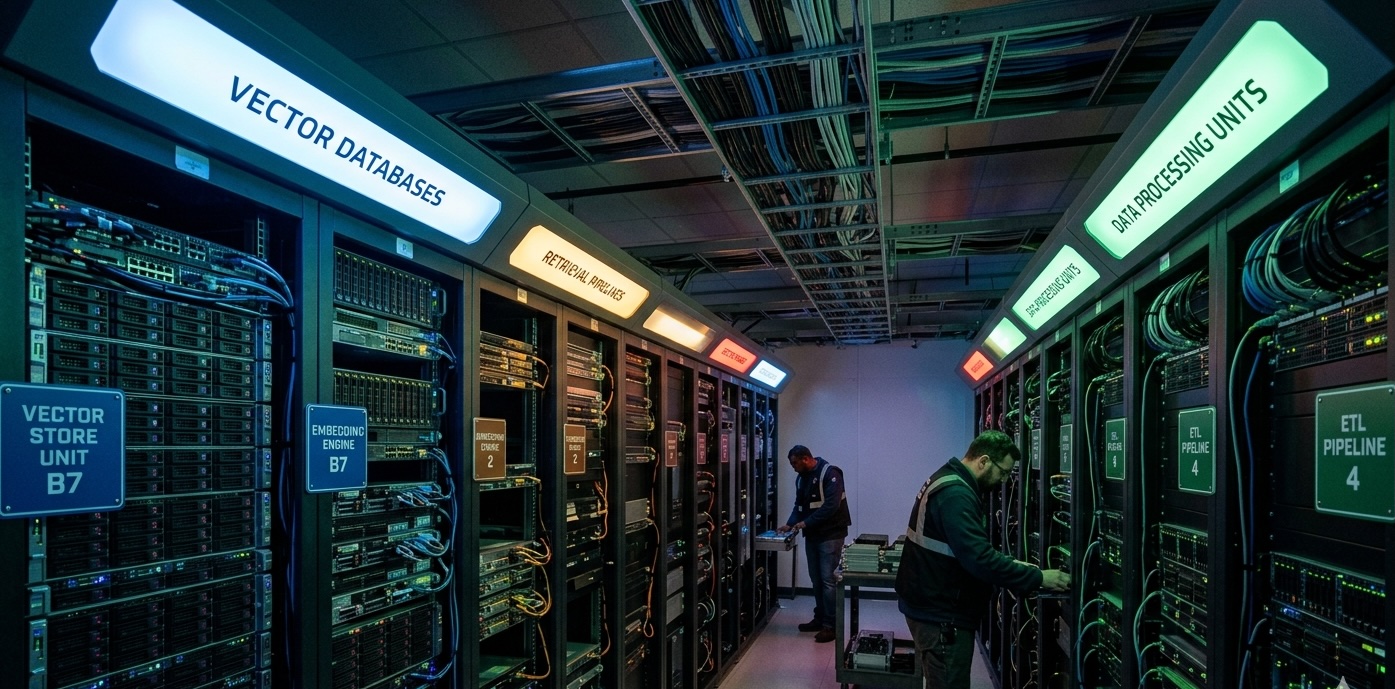
These vectors are stored in specialized databases like Pinecone, Weaviate, Qdrant, or Milvus.
The Hidden Craft: Semantic Chunking
Enterprise documents are rarely small. They may contain hundreds of pages of contracts, technical manuals, or regulatory procedures.
These documents must be divided into smaller pieces called chunks before being embedded. Naively splitting documents every fixed number of tokens can destroy meaning.
Consider a recipe broken in the middle of the instructions:
…remove the turkey from the oven and[END OF CHUNK]…put on your shoes and go for a walkThe context becomes useless.
Semantic chunking attempts to preserve logical boundaries within documents so that each chunk represents a coherent idea.
Reliable Enterprise AI pipelines use semantic chunking, with strategies that include:
- Recursive document splitting.
- Sliding window chunking with overlap.
- Embedding-based semantic segmentation.
Overlap is especially important. For example:
chunk_size = 500 tokensoverlap = 50 tokensThis ensures that important context at chunk boundaries is not lost.
In practice, retrieval quality often depends more on chunking strategy than on the language model itself.
RAG: Turning AI into a Researcher
Retrieval-Augmented Generation changes how LLMs answer questions.
Instead of asking the model to recall information from training data, the system dynamically retrieves relevant knowledge.
A typical RAG pipeline looks like this:
User Query ↓Query Embedding ↓Vector Search ↓Top Relevant Chunks ↓Context Injection into Prompt ↓LLM Generates AnswerThe model is no longer guessing, it is grounding its answer in retrieved evidence.
However, RAG does not completely eliminate hallucinations, it reduces them by constraining the model to relevant context.
Advanced systems further improve reliability using rerankers.
Example architecture:
Query↓Retrieve 20 chunks↓Reranker model selects top 3↓LLM generates answerThis additional step significantly improves answer quality.
Context Engineering: The Real Skill
The emerging discipline behind reliable AI systems is context engineering.
It involves designing how information flows into the model.
Key elements include:
- Retrieval strategy.
- Chunking structure.
- Prompt templates.
- Guardrails and constraints
- Tool integrations (Agents).
This layer is the core of Reliable Enterprise AI, designing the pipeline that ensures trust and correctness.
Frameworks that enable the pipeline
Building this architecture from scratch is possible but time-consuming.
Frameworks such as LangChain, LlamaIndex, and Haystack provide the modular components to build these pipelines, allowing developers to connect retrieval systems and external tools into structured workflows.
A simplified LangChain pipeline might look like:
Input | Retriever | Prompt Template | LLM | Output ParserThese frameworks allow developers to connect retrieval systems, language models, and external tools into structured workflows.
Some architectures also incorporate agents, which allow models to select tools dynamically – such as search engines, databases, or calculators – when solving complex tasks.
Reliability requires evaluation
One of the most overlooked aspects of enterprise AI is evaluation. Traditional software can be tested with deterministic outputs, generative systems cannot.
Reliable AI pipelines therefore include evaluation loops. Common approaches include:
- Retrieval recall metrics.
- Groundedness evaluation.
- LLM-as-judge evaluation.
- Frameworks such as RAGAS.
Without systematic evaluation, organizations cannot measure whether their AI system is improving or silently degrading. Reliable Enterprise AI integrates continuous evaluation loops into deployment.
From prototype to production: MLOps
A working demo is not a production system. Enterprise deployments require infrastructure capable of scaling and maintaining reliability.
Typical production stacks include:
- Containerization with Docker.
- Orchestration via Kubernetes.
- Monitoring and logging systems.
- Versioned models and datasets.
- Automated deployment pipelines.
This discipline is known as MLOps. It ensures that AI systems remain stable under real-world workloads.
The real lesson
Generative AI hype focuses on prompts. Reliable Enterprise AI focuses on architecture.
The difference between a fragile demo and a mission-critical AI system lies in:
- High-quality document chunking.
- Robust retrieval pipelines.
- Evaluation frameworks.
- Disciplined deployment infrastructure.
Prompting is only the final layer, the real engineering happens underneath.
As AI systems increasingly support decisions in healthcare, finance, and infrastructure, “mostly correct” will not be enough.
The next generation of AI systems must be verifiable by design.
Some information may be outdated